With funding from a London National Park City small grant, and in collaboration with Dr David Anderson, this research and public engagement project explored the BT Tower’s influence on skyline protection, signal infrastructure, and urban planning, sixty years on from its public opening.
Heralded in the 1960s as a symbol of ‘the technical and architectural skills of this modern age’, the tower has been an icon of publicly owned national infrastructure. But in the context of its planned re-development into a hotel and leisure facility, we have invited Londoners to think about how development, view management, and privatised public spaces are shaping our urban commons.
‘Signals and Sightlines’ offers a new framework for reflecting on the city in new ways, by emphasising the interplay of technological, aesthetic, and strategic factors in maintaining cityscapes, views, and infrastructure connectivity.
Outputs from the project include:
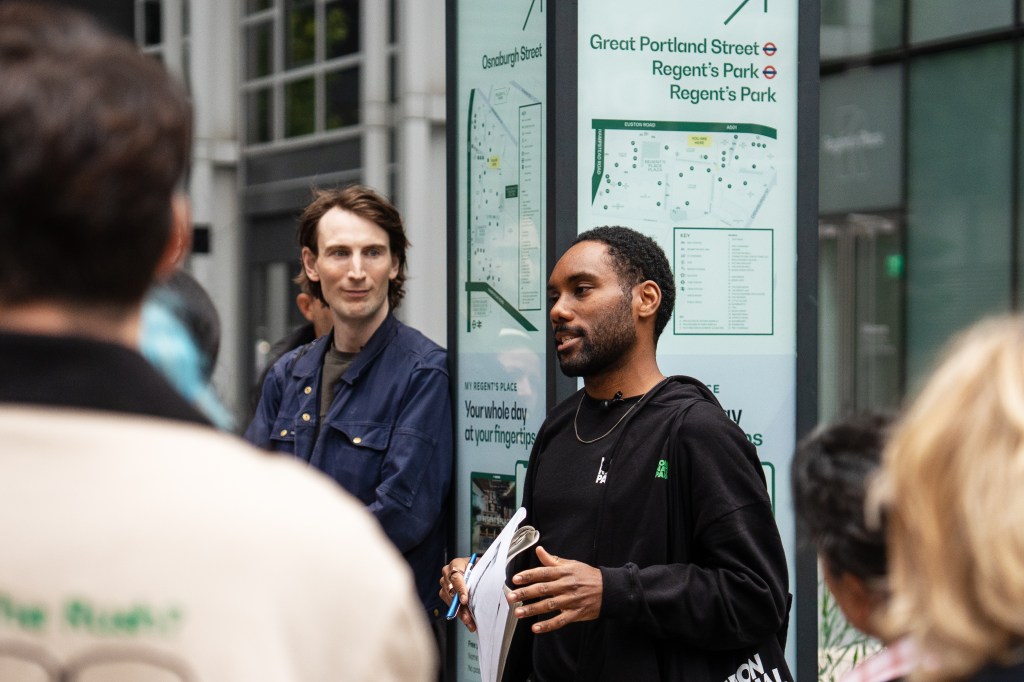
- a series of guided walks, organised during the London Walking Festival, Open House Festival, and as part of the Critical Debates in Interdisciplinary Urban Studies module of the MSc Urban Studies at UCL;
- the creation of a narrated audio guide and step-by-step route instructions in the Go Jauntly app;
- the production of a pamphlet with research excerpts and a route guide available across venues in Fitzrovia.
- a launch event for the publication at the London National Park City Visitors Centre.
You can access a pdf version of the pamphlet, or pick up a physical copy at the London National Park City Visitors Centre (80 Mortimer Street, London W1W 7FE), or The Building Centre (26 Store Street, London, WC1E 7BT).
If you don’t have access to the Go Jauntly app, you can follow the route using the online map and Spotify for the audio guide.
The graphic design for the project was created in collaboration with Clara Robson and Maks Rzeszotarski.
